





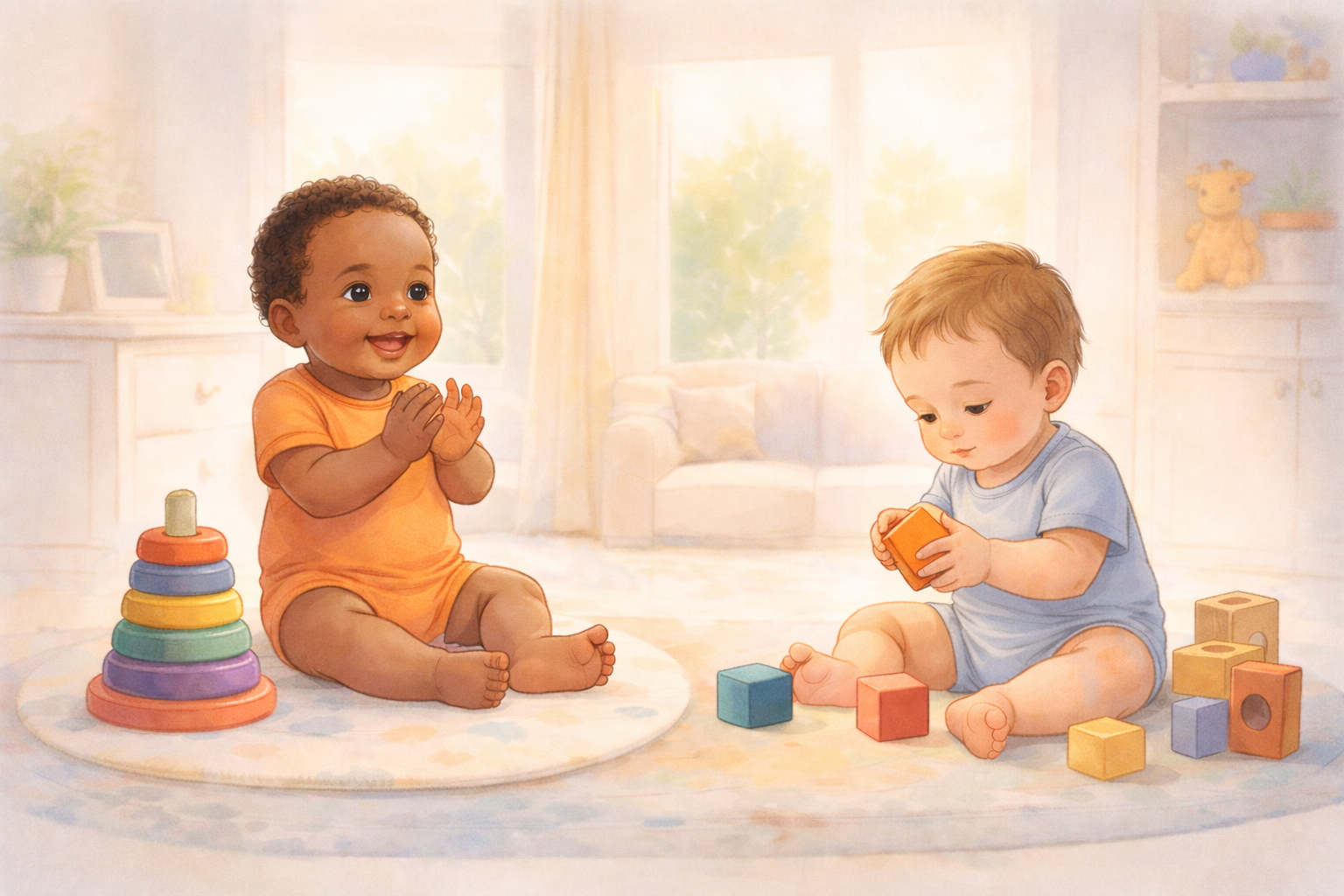

The “Normal Range” Mindset: Why Two Babies Can Look Totally Different
At some point, almost every parent notices it.
Two babies. Same age. Same milestone window. Completely different everything.
One naps on schedule. The other treats sleep like a negotiation.
One eats eagerly. The other takes their time.
One hits milestones early. The other seems in no rush at all.
And suddenly the question shifts from “Is my baby okay?” to something harder to name:
“Why does everyone else’s baby look so different from mine?”
Understanding the idea of a normal range—and why it exists—can bring a lot of relief to that moment.
What “Normal Range” Actually Means in Infant Development
When pediatricians talk about normal development, they’re rarely referring to a single age, number, or behavior.
They’re talking about a range of variation that accounts for:
- Biology
- Temperament
- Environment
- Feeding style
- Growth pace
- And plain old individuality
For most milestones, there’s a wide window in which babies typically land. Some arrive early. Some arrive later.
Both can fall well within healthy development.
That’s why two babies can look completely different—and still both be doing just fine.
Why Comparison Feels Unavoidable (and Heavier Than Expected)
Parents often say comparison sneaks up on them.
It shows up:
- At pediatrician visits
- In group chats
- Inside milestone trackers
- During casual conversations that weren’t meant to mean anything
Many parents describe feeling calm—until they hear:
“Oh, mine already does that.”
What follows is rarely curiosity. It’s usually self-doubt.
The issue isn’t that parents don’t understand ranges exist.
It’s that ranges feel abstract when you’re living with one very specific baby.
What Parents Tend to Fixate On (and Why)
From lived experience, parents often latch onto:
- Percentiles
- Milestone timing
- Daily totals (sleep hours, ounces, feeds)
These numbers feel concrete. Reassuring, even.
But without context, they can create more questions than answers.
A percentile doesn’t describe a baby.
It describes where one measurement landed on one day.
What Matters More Than Where a Baby Lands
Pediatric guidance tends to focus on patterns over position.
Three questions often carry more weight than comparison:
- Is your baby making progress over time?
- Is development moving forward, even if unevenly?
- Does your baby generally recover, adapt, and engage?
When those answers point toward steady movement, variation is usually expected.
Progress matters more than position.
Patterns matter more than single moments.
Why “Normal” Looks Different at Home Than on Charts
Charts and timelines compress reality.
They don’t show:
- Skipped naps during growth spurts
- Uneven weeks followed by sudden leaps
- Babies who focus energy on one skill at a time
Parents often share that the weeks they worried most were followed by noticeable shifts—without any intervention.
Development rarely unfolds evenly. It unfolds in bursts.
Where Context Changes the Conversation
This is where many parents feel stuck.
They know ranges exist.
They still wonder whether their baby fits.
Context helps bridge that gap:
- Age and developmental stage
- Recent changes
- What’s typical for this baby
- How patterns are evolving over time
That’s why some parents prefer asking questions in a place that already understands their baby’s context, rather than comparing against generalized timelines.
With Coddle, parents often ask questions like:
“My baby isn’t doing what others are at this age, but here’s what is happening—does this fit a normal range?”
Because the guidance adapts to age, development, and what’s been happening over time (when logged), the focus stays on interpretation—not comparison.
And when something truly falls outside expected ranges, Coddle clearly suggests reaching out to a pediatrician.
Why Two Babies in the Same Range Can Still Look Opposite
Even within the same developmental window, babies differ in:
- Pace
- Focus
- Energy distribution
- Sensitivity to change
One baby may pour effort into motor skills first.
Another into language or social engagement.
This doesn’t mean one is ahead and the other behind.
It often means they’re prioritizing differently.
Many parents find reassurance once they stop expecting symmetry.
When Comparison Is Worth Pausing On
Comparison tends to spike during:
- Growth spurts
- Regressions
- Transitions (starting solids, dropping naps)
- Right after doctor visits
In these moments, it can help to zoom out and ask:
- Is this a moment, or a trend?
- Is my baby otherwise engaged and responsive?
- Has anything else shifted recently?
Hold the “Normal Range” Idea
Normal range isn’t about settling or lowering expectations.
It’s about understanding that development allows room for difference.
Many parents say the pressure eases when they stop asking:
“Why isn’t my baby like that?”
And start asking:
“What does progress look like for this baby?”
Two babies can look totally different and still be well within normal.
What matters most is:
- Forward movement
- Responsiveness
- Patterns over time
When those pieces are present, variation is often part of healthy development, not a sign that something is wrong.
Support that helps you interpret what you’re seeing without comparison or judgment can make that difference easier to live with, day to day.
This article is informational and not a substitute for medical advice. Always consult your pediatrician with concerns.