



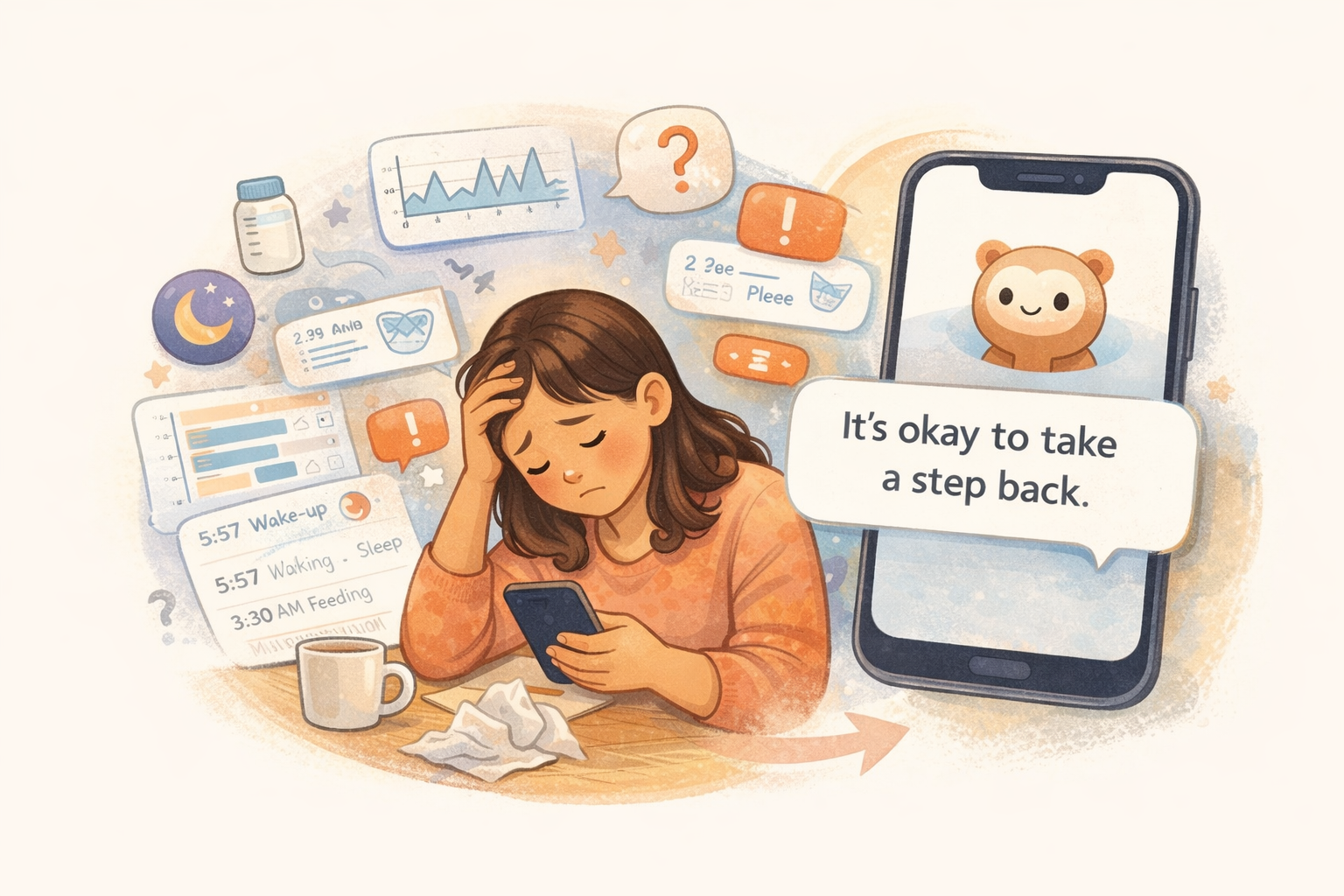

When Baby Tracking Becomes Anxiety: How to Step Back Safely
Baby Tracking starts with good intentions.
You log:
- feeds
- naps
- diapers
- wake windows
- ounces
- spit-up
- gas
- mood
At first, it feels reassuring.
“If I can see it, I can manage it.”
Then one day you realize: you’re checking the app more than you’re watching your baby.
You’re adjusting plans based on one short nap. You’re panicking over one lighter feed. You feel tense when you forget to log.
That’s the moment tracking shifts from helpful to heavy.
This isn’t about abandoning awareness. It’s about stepping back safely.
Why Tracking Feels So Powerful
Data reduces uncertainty.
Especially in early parenthood, where:
- sleep is fragmented
- memory is unreliable
- patterns feel invisible
- advice conflicts
Tracking offers something stable.
But sleep deprivation changes how we interpret data. Small fluctuations start to feel like trends. Single events start to feel predictive.
The problem isn’t tracking itself. It’s scale.
The Three Signs Tracking Is Increasing Anxiety
1. You React to Single Data Points
One short nap. One skipped feed. One green diaper.
And you change the whole day.
Patterns matter. Single moments usually don’t.
2. You Feel Guilty for Missing Logs
If you miss an entry and feel:
- behind
- disorganized
- irresponsible
The tool is controlling you, not supporting you. Newborn life is inconsistent. Your support system should tolerate that.
3. You’re Seeking Certainty, Not Context
If tracking becomes:
- “Is this exactly right?”
- “Did I hit the ideal window?”
- “Are we on track?”
Instead of:
- “Is my baby stable?”
- “Are hydration and alertness steady?”
- “Is this within range?”
Anxiety is driving interpretation.
The Myth of Perfect Patterning
Newborn data is naturally messy.
AAP guidance emphasizes:
- trends over time
- growth across weeks
- hydration consistency
- behavioral baseline
Not:
- exact hourly precision
- identical daily totals
When tracking becomes hyper-detailed, it can amplify normal variability. And normal variability is constant in the first year.
How to Step Back Safely (Without Ignoring Signals)
This is important. We are not advocating blind parenting. We’re shifting from hyper-tracking to intentional monitoring.
Step 1: Choose One Anchor Metric
Instead of tracking everything, prioritize:
- feeding frequency
- wet diapers
- or sleep totals (not exact timing)
Pick one. If that remains steady, most fluctuations are noise.
Step 2: Use the 48–72 Hour Rule
Before adjusting, ask:
Has this repeated for multiple days?
If no — observe. If yes — investigate.
Most developmental shifts stabilize quickly.
Step 3: Stop Logging “Just in Case”
Log when:
- you genuinely need clarity
- you’re testing a pattern
- your pediatrician advised tracking
Don’t log out of fear.
Step 4: Reconnect With Your Baby, Not the Graph
Spend one full wake window:
- watching cues
- noticing engagement
- observing behavior
- without logging
If your baby seems:
- alert
- responsive
- feeding
- hydrated
You’re likely within normal range.
Where a Parenting Assistant Makes the Difference
Here’s the nuance. The answer isn’t “stop using apps.” It’s use tools designed for nervous systems, not dashboards.
Coddle’s design principle
Support without pressure
- Works even if you skip logging
- Doesn’t rely on streaks or gamification
- Interprets trends across days, not isolated entries
- Keeps the assistant front and center — not charts
- Offers one grounded next step instead of performance metrics
- Includes mood check-ins (because caregiver wellbeing matters too)
If you log lightly, it adapts. If you skip a day, nothing breaks. If you feel overwhelmed, it doesn’t escalate you.
Instead of: “You’re behind.”
It offers: “Here’s what likely matters.”
When Tracking Is Clinically Necessary
There are times when structured tracking matters:
- weight gain concerns
- feeding challenges
- dehydration risk
- medical instruction
- prematurity
- specific pediatric guidance
In those cases, tracking supports safety.
But once stability returns, hyper-detail usually isn’t required.
Featured read
What Baby Patterns Actually Matter
If symptom interpretation is driving anxiety, this helps you separate signal from noise — without spiraling.
The Real Goal
Tracking is a tool.
Not a performance review.
Not a parenting grade.
Not a predictor of your baby’s future.
If it’s helping you feel steady, keep it.
If it’s increasing tension, scale it back — intentionally.
The healthiest version of tracking is:
- flexible
- contextual
- optional
- and supported by guidance
Not perfection.
You don’t need to measure every minute to be a responsive parent.
You need:
- awareness of meaningful signals
- tolerance for variability
- support that reduces — not increases — mental load
When tracking becomes anxiety, stepping back isn’t negligence.
It’s recalibration. And using tools that respect that recalibration makes all the difference.


