





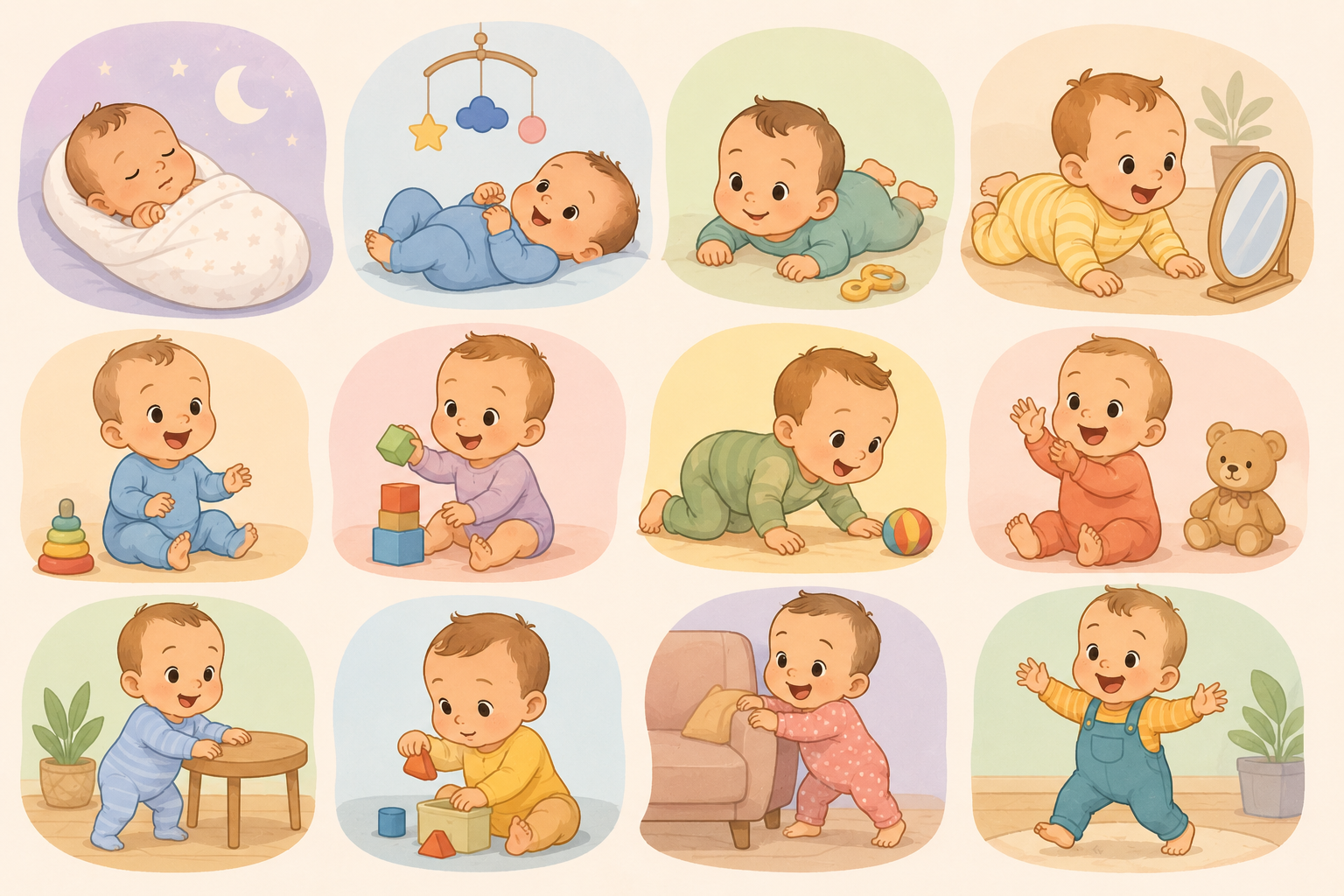

Baby Milestones by Month: 0-12 Months
One day, your baby is a sleepy newborn who mostly eats, sleeps, and wants to be held constantly.
And before you fully adjust to that stage, suddenly they’re:
- smiling at you intentionally
- grabbing your shirt during feeds
- rolling across the floor
- babbling loudly at 5 a.m.
- crawling toward something unsafe at a surprising speed
The first year moves:
Beautifully fast.
Emotionally fast.
Sometimes overwhelmingly fast.
And somewhere along the way, many parents quietly begin wondering:
“Should my baby be doing this already?”
“Why is another baby the same age doing more?”
“Am I missing something?”
If you’ve had those thoughts, you are far from alone.
But before diving into milestones month by month, this matters most: This is not a guide here to make parents analyze every single month.
0-1 Month: The “adjusting together” stage
The early weeks are often less about milestones and more about adjustment.
For the baby, and honestly, for parents too.
Most days revolve around: feeding, sleeping, soothing, diaper changes, repeating everything again
At this stage, many babies:
- recognize familiar voices
- calm when held close
- make brief eye contact
- startle easily
- sleep in short stretches
And many parents at this stage can feel beautiful and overwhelmed at the same time.
2 Months: The first real smiles
Around this stage, many parents experience one of the first moments that feels deeply interactive: a real social smile.
Many babies may also:
- coo
- watch faces closely
- follow movement with their eyes
- briefly lift their head during tummy time
Parents often start feeling: “Okay… we’re finally connecting.”
Sometimes the first smiles are also the moment parents begin feeling emotionally connected for the first time. And sometimes that connection takes longer.
You may also read: “I Don’t Feel Bonded Yet”: Normal Timelines and Gentle Bonding Ideas
3 Months: more personality starts showing up
Around this age, babies often seem much more awake to the world.
Parents may notice:
- more movement and kicking
- longer awake windows
- stronger reactions to voices
- early attempts to grab toys
- more expressive sounds
Some babies also begin showing early rolling attempts.
And many parents suddenly realize: “You really can’t leave them unattended anymore.”
4 Months: the “everything changed overnight” stage
This stage can feel exciting and exhausting all at once.
Many babies become:
- more social
- more physically active
- more curious about everything around them
Some begin:
- laughing
- rolling attempts
- grabbing objects intentionally
- bringing everything to their mouth
And for many families, sleep suddenly becomes unpredictable again.
Parents often wonder: “Why was my baby sleeping better before?”
Developmental leaps and sleep changes often overlap during the first year.
Rolling is also one of the first major movement milestones parents become emotional about.If rolling timing has been causing anxiety, this may help: “Baby Rolling Early or Late: What’s Actually Normal?”
5 Months: constant curiosity
At this stage, many babies seem busy all day long.
Everything becomes interesting: hands, faces, toys, pets, cords, your glasses
Many babies:
- roll more consistently
- reach intentionally
- babble more
- respond socially during play
- explore constantly with their mouth
And parents often realize how quickly development starts accelerating once mobility begins.
6 Months: halfway through the “First Year”
This stage often feels emotional for parents.
Because the newborn phase already feels far away.
Many babies around this age may:
- sit with support
- roll both ways
- recognize familiar people clearly
- show excitement during play
- begin solids
Some babies sleep better around this stage. Some suddenly sleep worse.
And many parents quietly start comparing milestones more than they expected they would.
When every other baby online seems ahead
At some point during the first year, many parents begin comparing even when they don’t want to.
One baby is already crawling.
Another is saying sounds early.
Someone else’s baby sleeps through the night.
And after enough scrolling, milestones can stop feeling exciting and start feeling stressful.
Suddenly, parents start wondering: “Wait… is my baby behind?”
But baby development rarely happens evenly.
And this is where generic milestone charts online sometimes make anxiety worse: they don’t know your baby.
That’s where assistants like Coddle can feel more reassuring for parents.
Because Coddle understands the baby’s age, recent patterns, and pediatric guidance, it can help parents interpret those moments more calmly instead of immediately assuming something is wrong.
So instead of endlessly searching:
“Should my 6-month-old be crawling?”
“Is it normal that my baby isn’t rolling yet?”
“Why is my baby suddenly clingy?”
“Should I worry if my baby isn’t babbling much?”
“Is my baby developing normally?”
…parents can ask questions based on their own baby’s journey, not random comparisons.
And often, what anxious parents need most is not another milestone checklist.
They need a calmer perspective, context, and reassurance while navigating a stage where everything changes month by month.
7–8 Months: movement changes everything
This is often when babies become determined explorers.
Many begin:
- scooting
- crawling
- pulling toward furniture
- moving across rooms surprisingly fast
Parents often experience two emotions at once: pride and panic.
Because once mobility starts, life changes quickly.
Many babies also become:
- louder
- clingier
- more aware when parents leave
- strongly attached to familiar caregivers
Separation anxiety may begin around this stage, too.
9 Months: “Big Personality Stage”
By now, many babies feel less like newborns and more like tiny people with opinions.
Parents may notice:
- favorite toys
- babbling conversations
- frustration when something is taken away
- stranger anxiety
- very clear preferences
Some babies crawl everywhere.
Some still prefer rolling or scooting.
Some pull to stand early.
Development rarely moves in one straight line.
10 Months: curiosity everywhere
At this stage, babies are often deeply curious.
Which usually means:
- opening cabinets
- grabbing cords
- chasing pets
- climbing unexpectedly
- finding unsafe things instantly
Many babies also become more socially interactive:
- waving
- copying sounds
- responding to their name
- understanding familiar routines
Parents often spend this stage saying, “How did you even reach that?”
11 Months: almost a “Toddler”
This stage can feel emotional because the first birthday suddenly feels close.
Some babies:
- cruise along furniture
- stand briefly
- say first words
- communicate wants clearly
Others may still focus more heavily on crawling and movement.
Both can still fall within a healthy range of development.
12 Months: One Whole Year
The first birthday often feels emotional for parents in unexpected ways.
Because somehow:
- the newborn stage disappeared
- the sleepless nights blurred together
- the tiny baby became a moving, expressive little person
By one year, many babies may:
- crawl confidently
- stand or walk with support
- imitate sounds and gestures
- understand familiar routines
- say simple words
And many parents realize something important: Their baby developed in their own unique way the entire time.
What if my baby isn’t hitting every milestone “On Time”?
One of the biggest worries parents carry during the first year.
But milestone timing often has a much wider range of normal than parents realize.
Usually, pediatricians look at the overall developmental picture, not one isolated milestone by itself.
Progress over time matters more than perfection on a chart.
Trusted Sources
-
American Academy of Pediatrics – HealthyChildren Developmental Milestones
-
Centers for Disease Control and Prevention (CDC) Developmental Milestones
-
National Institute of Child Health and Human Development (NICHD) Infant Development Resources
(This article is informational and not a substitute for medical advice.)